Cheapest Car Insurance Companies in 2026
Car insurance prices vary more between companies than most drivers expect — often by hundreds of dollars a year for the exact same coverage. This article looks at which insurers consistently post the lowest average rates in 2026, why “cheapest” changes depending on your age, location, and driving record, and how to actually find your lowest personal quote instead of relying on a national average.
Quick Answer
Across multiple independent 2026 rate analyses, USAA and Travelers consistently rank among the cheapest car insurance companies nationally, with GEICO, State Farm, and Progressive also showing up frequently near the top for full coverage. USAA is typically the cheapest overall, but it’s only available to military members, veterans, and their families. Regional insurers like Auto-Owners, Erie, and NYCM often beat national carriers on price in the states where they’re sold. The only way to know your true cheapest option is to compare quotes directly, since rankings shift by state, age, and driving record.
Why “Cheapest” Isn’t the Same for Everyone
National rankings of the cheapest insurer are built from a sample driver profile — often a specific age, ZIP code, vehicle, and coverage level. Your actual cheapest option can be completely different, because insurers weigh rating factors like age, location, credit-based insurance score (where allowed), vehicle type, annual mileage, and driving record differently from one another. A company that’s the cheapest nationally might not even be the cheapest in your state, and a company that’s expensive for a 20-year-old might be very competitive for a 45-year-old with a clean record.
Average Cost of Car Insurance in 2026
Recent 2026 industry rate studies put the national average cost of car insurance at roughly $2,300 to $2,600 per year for full coverage, or somewhere around $190–$215 a month, though estimates vary by data source and methodology. Minimum-coverage (liability-only) policies cost substantially less — commonly cited in the range of $1,500–$1,600 per year, or around $130 a month nationally.
These are blended national averages, not personalized quotes. Your own premium depends on:
- Your age and driving experience
- Your ZIP code and state
- The vehicle you drive
- Your driving record (accidents, tickets, DUIs)
- Your credit-based insurance score, in most states
- The coverage limits and deductible you choose
- Discounts you qualify for
Cheapest Car Insurance Companies Overall
Multiple independent rate studies from 2026 point to a similar shortlist of insurers that consistently post below-average premiums, though the exact ranking and dollar figures differ by source because each study uses a different sample driver and vehicle.
| Insurer | Best For | Why It’s Competitive | Important Consideration |
|---|---|---|---|
| USAA | Military families | Frequently the single cheapest insurer in national rate studies | Only available to active-duty military, veterans, and their immediate family |
| Travelers | Full coverage shoppers | Repeatedly ranks as the cheapest or near-cheapest large national carrier for full coverage in multiple 2026 studies | Sold primarily through independent agents rather than direct online purchase |
| GEICO | Broad availability and discounts | Competitive full-coverage pricing nationwide, plus stackable discounts (multi-vehicle, military, good driver) | Rates can vary more by state than some regional insurers |
| State Farm | Nationwide network and agents | Consistently ranks among the cheapest large insurers with strong local agent access | Rates vary significantly by state and driver profile |
| Progressive | Drivers with recent tickets or accidents | Often competitive for higher-risk driver profiles compared with some traditional carriers | Base rates aren’t always the lowest for clean-record drivers |
| Auto-Owners | Regional value | Frequently cited among the cheapest options where it’s sold, with a low complaint ratio | Regional carrier — not available in every state, sold only through independent agents |
| Erie | Regional value, teens and families | Often among the cheapest regional carriers with strong claims satisfaction scores | Available in a limited number of states |
Treat any “cheapest company” list — including this one — as a starting point. The company that ranks first in a national study is not guaranteed to be the cheapest for your ZIP code, vehicle, or driving history.
Cheapest by Coverage Type
“Cheapest” also depends heavily on whether you’re comparing minimum liability coverage or full coverage (liability plus collision and comprehensive).
- Minimum coverage satisfies your state’s legal requirement to drive but leaves you responsible for your own vehicle’s repair costs after an at-fault accident. Recent rate studies place national average minimum-coverage costs somewhere in the $35–$70 per month range depending on the insurer and methodology, making it the cheapest way to legally stay insured.
- Full coverage adds collision and comprehensive protection for your own vehicle and typically costs meaningfully more — commonly cited in the $95–$250 per month range nationally, depending on the study, your vehicle, and your driver profile.
If you’re financing or leasing your vehicle, your lender will typically require full coverage regardless of which is “cheaper.” If you own an older, lower-value car outright, minimum coverage (or minimum coverage plus limited add-ons) may be a more reasonable trade-off — though it comes with real financial risk if you cause a serious accident.
What Actually Drives Your Price
- Driving record. Accidents, moving violations, and especially DUIs raise premiums substantially — some 2026 industry data shows a DUI conviction can increase average rates by roughly 50–80%, though the exact increase varies by insurer and state.
- Age and experience. Teen and young-adult drivers pay dramatically more than experienced drivers, with rates typically declining in steps around ages 19, 21, and 25.
- Credit-based insurance score. In most states, insurers can factor in a credit-based insurance score, and drivers with poor scores often pay significantly more than those with strong scores. A handful of states — California, Hawaii, Massachusetts, and Michigan — prohibit or tightly restrict this practice, and several others (including Maryland, Oregon, and Utah) impose partial restrictions.
- Vehicle type. Insuring a modest sedan or SUV with strong safety ratings and lower repair costs is typically cheaper than insuring a sports car, luxury vehicle, or car with a high theft rate.
- Location. Rates vary significantly from state to state and even ZIP code to ZIP code, driven by factors like local accident rates, uninsured-driver rates, repair costs, and state insurance regulations.
- Coverage limits and deductible. Higher liability limits and lower deductibles both increase your premium; adjusting either changes your monthly cost accordingly.
Discounts and Ways to Save
Every major insurer offers some combination of discounts, though eligibility and the size of the discount vary by company and state.
- Multi-policy (bundling) discount — combining auto with renters or homeowners insurance
- Multi-vehicle discount — insuring more than one car on the same policy
- Good driver / accident-free discount — for maintaining a clean record over a set period
- Good student discount — for young drivers who maintain a set GPA
- Telematics / usage-based programs — apps or devices that track driving behavior (braking, speed, mileage) in exchange for a potential discount
- Military and federal employee discounts — offered by several major carriers
- Paid-in-full or autopay discounts — for paying the annual premium upfront or enrolling in automatic payments
- Low-mileage discounts — for drivers who log fewer miles annually than average
None of these discounts guarantees a specific dollar savings — actual amounts vary by insurer, state, and individual eligibility, so it’s worth asking each company directly which discounts apply to you.
State Differences
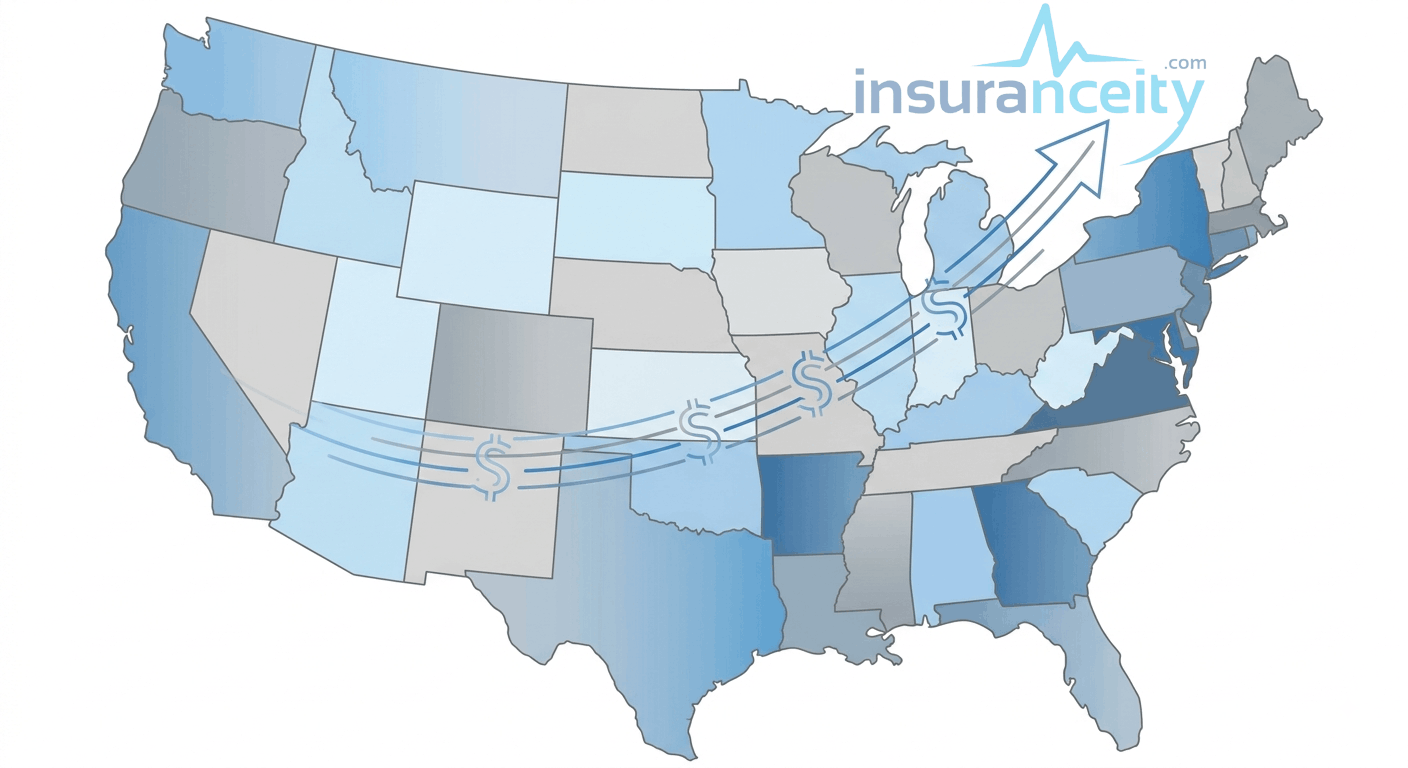
Car insurance costs and rules vary significantly by state, and a national “cheapest company” ranking will not necessarily hold true where you live.
- Cost ranges. Some states, including Vermont, Maine, and New Hampshire, tend to post some of the lowest average full-coverage premiums in national studies, while certain states consistently rank among the most expensive.
- Minimum coverage requirements. Nearly every state requires liability insurance, expressed as limits like 25/50/25, but the specific minimums differ by state and have changed recently in some states.
- Credit-based insurance score rules. As noted above, California, Hawaii, Massachusetts, and Michigan restrict or ban the use of credit-based scoring in auto insurance pricing, while most other states permit it.
- No-fault vs. at-fault systems. Some states require personal injury protection (PIP) regardless of fault; others use a traditional liability-based system.
Because these rules and average costs change, confirm current requirements with your state insurance department before assuming a national average or requirement applies where you live.
Cheapest Car Insurance by Driver Situation
| Situation | Companies Frequently Cited as Competitive | Consideration |
|---|---|---|
| Clean driving record | Travelers, GEICO, USAA (if eligible) | Base rates are typically lowest for low-risk profiles |
| Recent accident or ticket | Progressive, GEICO | Some insurers weigh recent incidents less heavily than others |
| Poor or limited credit | Insurers in credit-restricted states (CA, HI, MA, MI), or usage-based programs elsewhere | Usage-based/telematics programs can offset a weak credit-based score in other states |
| Young or teen driver | USAA (if eligible), Erie, Auto-Owners, State Farm | Staying on a family policy is typically cheaper than a standalone policy |
| Military-connected household | USAA | Eligibility limited to military members, veterans, and immediate family |
Pros and Cons of Chasing the Absolute Cheapest Rate
Pros
- Lower monthly and annual cost
- More budget available for higher liability limits or other financial priorities
- Some cheaper insurers still offer strong digital tools and claims service
Cons
- The cheapest available policy may carry only state-minimum liability limits, which can leave you financially exposed after a serious accident
- Some lower-cost insurers have smaller agent networks or less robust customer service infrastructure
- Regional “cheap” insurers may not be available if you move states
How to Find Your Actual Cheapest Rate
- Decide your coverage needs first — minimum liability, full coverage, or something in between — before comparing prices, so you’re comparing equivalent policies.
- Get quotes from at least three to five insurers, including at least one regional or independent-agent carrier if available in your state.
- Match coverage limits and deductibles exactly across every quote; a lower premium is meaningless if it comes with lower liability limits or a higher deductible than the other quotes.
- Ask about every discount you might qualify for — many aren’t applied automatically and require you to request them.
- Check the insurer’s financial strength rating (such as AM Best) and complaint record with your state insurance department before committing to a lower-cost but unfamiliar company.
- Re-shop annually, especially after a policy renewal increase, a change in credit, or once a ticket or accident ages off your record.
- Ask about usage-based or telematics programs if you’re a low-mileage or demonstrably safe driver — these can meaningfully lower cost regardless of your credit-based score.
- Read the policy before you buy, paying attention to exclusions and any coverage gaps that come with a lower-priced plan.
Common Mistakes to Avoid
- Assuming a national “cheapest company” list applies to you. Rankings are built from sample profiles that may not match your age, state, or driving record.
- Comparing quotes with different coverage limits. A lower price is often just lower coverage, not a better deal.
- Letting a policy lapse to save money short-term. A coverage gap can raise future premiums and, in most states, is illegal while a vehicle remains registered.
- Ignoring the total cost of a cheap policy with a high deductible. A low premium paired with a very high deductible can cost more out of pocket after a claim.
- Not asking about discounts. Many discounts require you to proactively request them or submit documentation.
- Overlooking regional insurers. Some of the lowest rates in a given state come from regional carriers that don’t show up in every national comparison.
Frequently Asked Questions
What is the cheapest car insurance company overall?
USAA frequently posts the lowest average rates in national 2026 rate studies, but it’s only available to military members, veterans, and their immediate families. Among companies available to the general public, Travelers, GEICO, and State Farm are commonly cited as some of the cheapest large national carriers, though rankings shift by state and driver profile.
Is minimum coverage always the cheapest option?
Minimum liability coverage is typically the lowest-cost way to legally insure a vehicle, but it may not cover your own vehicle’s repairs or a serious at-fault accident’s full cost, which could leave you personally responsible for expenses beyond your policy’s limits.
Can I get cheap car insurance with bad credit?
In most states, a lower credit-based insurance score can increase your premium. California, Hawaii, Massachusetts, and Michigan prohibit or restrict this practice, so drivers in those states aren’t affected by credit-based pricing. Elsewhere, usage-based/telematics programs and shopping around across multiple insurers can help offset the impact.
Does the cheapest insurer change after an accident or ticket?
Yes. Insurers weigh recent violations differently, so a company that isn’t the cheapest for a clean-record driver may become more competitive — or less competitive — after an incident. It’s worth re-shopping specifically after any change to your driving record.
Are regional insurance companies cheaper than national brands?
Regional carriers like Erie, Auto-Owners, and NYCM are frequently cited among the cheapest options in the specific states where they operate, sometimes beating larger national brands. Their availability is limited to certain states, so they aren’t an option for every driver.
Will bundling my home and auto insurance make it cheaper?
Bundling policies with the same insurer commonly qualifies you for a multi-policy discount, though the size of the discount and whether it’s the cheapest overall option depends on the insurer and your specific policies — it’s worth comparing a bundled quote against separate quotes from different companies.
How often should I shop for cheaper car insurance?
Many industry sources recommend comparing quotes at least once a year, or any time your renewal price increases, your credit profile changes, you move, or a ticket or accident ages off your driving record.
This article provides general educational information about car insurance and is not personalized financial, legal, or insurance advice. Insurance pricing, discount programs, and state rules change over time and vary by insurer and location. Confirm current requirements with your state insurance department and get personalized quotes directly from insurers or a licensed agent before making a purchasing decision.
Sources
- National Association of Insurance Commissioners (NAIC) — “Auto Insurance” — https://content.naic.org/insurance-topics/auto-insurance — Regulatory overview of auto liability coverage and general state rules.
- U.S. News & World Report — “Cheapest Car Insurance Companies of 2026” — https://www.usnews.com/insurance/auto/cheapest-car-insurance-companies — Independent rate analysis identifying the cheapest national insurers and average annual cost.
- NerdWallet — “Cheap Car Insurance Companies” — https://www.nerdwallet.com/insurance/auto/cheapest-car-insurance — Rate analysis across 130+ insurers for minimum and full coverage cost comparisons.
- MoneyGeek — “Cheapest Car Insurance Companies for 2026” — https://www.moneygeek.com/insurance/auto/cheapest-car-insurance-companies/ — Comparative full-coverage and minimum-coverage rate data by company and state.
- Forbes Advisor — “Cheapest Car Insurance of 2026” — https://www.forbes.com/advisor/car-insurance/cheapest-car-insurance/ — Rate analysis across driver profiles including accidents, tickets, DUIs, and credit tiers.
- CNBC Select — “Cheapest Car Insurance Companies of July 2026” — https://www.cnbc.com/select/best-cheap-car-insurance/ — Independent review of low-cost insurers and national average cost data.
- Experian — “Average Cost of Car Insurance in the US for 2026” — https://www.experian.com/blogs/ask-experian/average-cost-car-insurance/ — National and state-level average premium data for minimum and full coverage.
- CNBC — “Home, car insurance rates based on credit history face state scrutiny” — https://www.cnbc.com/2026/04/26/insurance-rates-credit-history.html — Coverage of which states restrict credit-based insurance scoring.