Best Homeowners Insurance Companies
Choosing a homeowners insurer is a bigger decision than it looks — the cheapest policy isn’t always the one that pays out smoothly when you actually file a claim. Independent industry studies from groups like J.D. Power, Insure.com, and NAIC track which insurers combine competitive pricing with strong claims service and financial stability, and a small group of companies shows up near the top across multiple studies year after year.
This guide breaks down which insurers consistently rank well in 2026, what each tends to be best at, and how to evaluate homeowners insurance for your own situation.
Quick Answer
Across multiple independent 2026 rankings, Amica consistently rates highest overall, combining below-average rates with strong customer satisfaction and a low complaint ratio. Travelers and Allstate also rank near the top in several major studies. Chubb stands out for high-value homes needing broad liability limits, USAA rates highly but is limited to military members and their families, and State Farm remains the largest insurer by market share with generally solid satisfaction scores. No single company is “best” for every homeowner — the right fit depends on your home’s value, location, and what you prioritize most.
How “Best” Is Actually Measured
Rankings like these are typically built from a mix of:
- Customer satisfaction surveys, measuring policyholder satisfaction, likelihood to renew, and likelihood to recommend.
- NAIC complaint index data, which tracks how many complaints an insurer receives relative to its size — a lower ratio generally signals better service.
- J.D. Power claims satisfaction studies, which specifically measure how well insurers handle the claims process, often considered the most important real-world test of an insurer.
- AM Best financial strength ratings, which indicate an insurer’s ability to pay out claims, especially important after large-scale disasters.
- Average rate data, usually sourced from ratings agencies like Quadrant Information Services for a sample homeowner profile.
Different publications weight these factors differently, which is why rankings vary somewhat from source to source. Treat any “best” list — including this one — as a starting point for getting quotes, not a guarantee of your own experience.
Top-Rated Homeowners Insurance Companies
| Company | Frequently Cited As Best For | Notable Strength | Consideration |
|---|---|---|---|
| Amica | Overall satisfaction and claims handling | Ranks highly in J.D. Power’s claims satisfaction study and Insure.com’s annual survey, with a low NAIC complaint ratio | Not typically the cheapest option in every market |
| Travelers | Balance of price and service | Ranks near the top in multiple 2026 studies for low complaint volume and solid financial standing | Rates and availability vary significantly by state |
| Allstate | Digital tools and agent access | Strong mobile app for policy management and claims tracking, plus a large agent network | Among the higher-complaint carriers in some studies |
| Chubb | High-value homes and broad liability | Very high liability limits (sometimes cited up to $100 million in excess coverage) and strong claims service for high-value properties | Premiums are generally higher than mass-market insurers |
| USAA | Military members and their families | Frequently rated highly for both price and satisfaction | Only available to military members, veterans, and their immediate families |
| State Farm | Widespread availability and agent support | Largest homeowners insurer by market share, with a large local agent network | Rankings have shifted in recent studies amid rate increases in some states |
| Progressive | Bundling home and auto | Frequently cited among the best for bundling discounts and new-home discounts | Also cited in some studies as having a comparatively higher complaint rate |
This list reflects companies that repeatedly appear near the top of independent studies — it is not an exhaustive ranking of every insurer, and regional/mutual insurers (state-specific companies) are often excluded from “national” rankings simply because they don’t operate broadly enough to qualify, not because they’re worse.
Average Cost of Homeowners Insurance
National average estimates for 2026 vary depending on the study’s sample home and coverage amount, generally ranging from roughly $1,900 to $2,550 a year for a home with a moderate dwelling coverage amount (commonly $250,000–$400,000). Several recent analyses note rates have risen meaningfully — one 2026 industry rate study cited roughly a 6% year-over-year increase — driven largely by higher construction and material costs and an increase in weather-related claims.
Your actual premium depends on:
- Location. Homes in wildfire, hurricane, hail, or flood-prone areas typically pay more, and availability itself can be limited in the highest-risk zip codes.
- Home age, construction, and roof type. Older homes, and certain roofing materials, can raise premiums or trigger inspection requirements.
- Dwelling coverage amount. Higher rebuild-cost coverage costs more but may be necessary to avoid being underinsured.
- Claims history. Homes with recent claims, especially water damage claims, often see higher renewal rates.
- Credit-based insurance score. Used as a rating factor in most states, with some state-level restrictions.
- Deductible. Higher deductibles generally lower your premium but increase what you pay out of pocket per claim.
An advertised or average rate is not the same as your personalized quote — always compare actual quotes for your specific home.
Homeowners Insurance Coverage, Explained
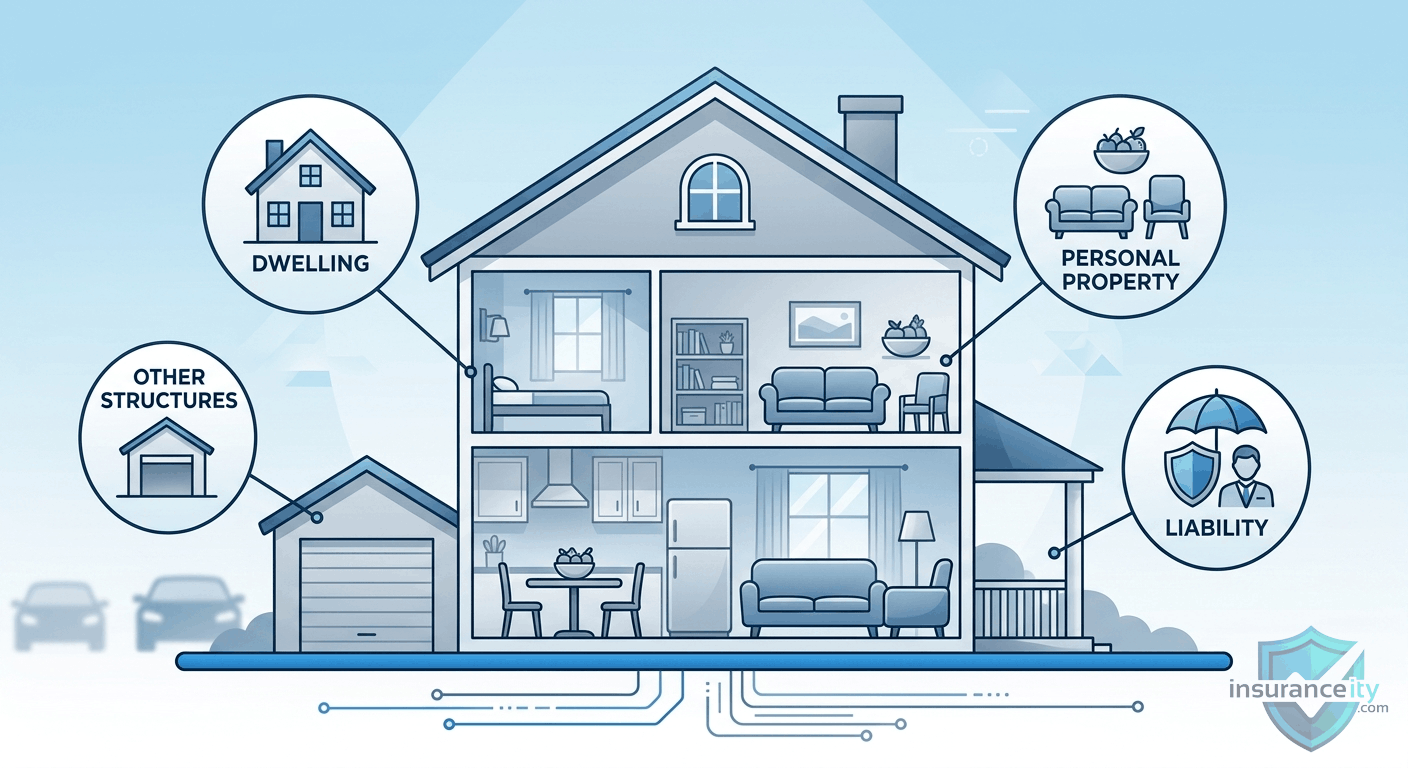
A standard homeowners policy is typically built from several coverage parts, often labeled Coverage A through F:
- Dwelling coverage (Coverage A) pays to repair or rebuild the physical structure of your home after a covered loss, such as fire or wind damage.
- Other structures coverage (Coverage B) covers structures not attached to the home, like a detached garage, shed, or fence.
- Personal property coverage (Coverage C) covers your belongings — furniture, electronics, clothing — if damaged, destroyed, or stolen. Coverage is typically a percentage of your dwelling limit, and high-value items like jewelry or art may need additional riders.
- Loss of use / additional living expenses (Coverage D) helps pay for temporary housing and related costs if your home becomes uninhabitable after a covered loss.
- Personal liability coverage (Coverage E) protects you financially if you’re found responsible for someone else’s injury or property damage.
- Medical payments to others (Coverage F) covers minor medical costs for a guest injured on your property, regardless of fault.
Standard policies typically exclude certain perils. Flood damage and earthquake damage are generally not covered by a standard homeowners policy and usually require separate coverage — flood insurance is commonly purchased through the National Flood Insurance Program (NFIP) or a private insurer, and earthquake coverage is typically a separate policy or endorsement, especially relevant in states like California.
Discounts and Ways to Lower Your Premium
Availability and savings vary by insurer and state, so treat these as possibilities to ask about, not guarantees:
- Bundling home and auto (or other policies) with the same insurer can qualify you for a multi-policy discount.
- Home safety and security features, such as monitored alarm systems, smoke detectors, and deadbolts, may reduce your premium.
- Newer roofs and updated electrical, plumbing, or HVAC systems can lower risk and may qualify for a discount, since older systems are more likely to cause claims.
- Claims-free history and loyalty discounts are offered by some insurers for long-term, claim-free policyholders.
- Higher deductibles reduce your premium in exchange for more out-of-pocket risk if you file a claim.
- Paying in full or enrolling in autopay/paperless billing can qualify for a modest discount with some insurers.
Homeowners Insurance in High-Risk States
Coverage cost and availability differ significantly depending on regional disaster risk:
- Wildfire-prone states like California have seen some major insurers limit new policy sales in high-risk zip codes in recent years, pushing more homeowners toward state-backed “insurer of last resort” plans (such as California’s FAIR Plan) or specialty/surplus-lines carriers.
- Hurricane- and flood-prone states along the Gulf Coast and Atlantic coast, including Florida and Louisiana, often see higher premiums and separate wind/hail deductibles, along with a greater need for supplemental flood insurance.
- Hail- and severe storm-prone states in the Midwest can also see above-average premiums due to frequent roof and property damage claims.
Because availability and pricing in these markets can change quickly as insurers adjust their risk appetite, homeowners in high-risk areas should confirm current options directly with their state insurance department or a licensed local agent rather than relying on national averages.
Who Each Top-Rated Option Tends to Suit Best
- Best for overall satisfaction and claims handling: Amica, based on its consistent top rankings in claims satisfaction studies and low complaint ratios.
- Best for high-value homes: Chubb, given its high liability limits and reputation for handling large or complex claims.
- Best for military families: USAA, for those who qualify.
- Best for bundling: Progressive and Allstate, both frequently cited for competitive multi-policy discounts.
- Best for wide agent access: State Farm and Allstate, both with large local agent networks for in-person support.
- Best for digital-first management: Allstate and Progressive, both cited for strong mobile app experiences.
Pros and Cons
Amica
- Pros: Strong claims satisfaction scores, low complaint ratio, broadly competitive rates.
- Cons: Only sells homeowners insurance directly (no independent agent network), which some shoppers may find less flexible.
Chubb
- Pros: Very high liability and rebuild-cost limits, strong service reputation for high-value homes.
- Cons: Premiums are generally higher, and it may not be the most cost-effective option for a standard, moderately valued home.
State Farm
- Pros: Extensive local agent network, largest market share, broad product lineup for bundling.
- Cons: Recent rate increases in some states have affected its satisfaction rankings relative to prior years.
USAA
- Pros: Frequently top-rated for both price and service.
- Cons: Eligibility limited to military members, veterans, and their immediate families.
How to Choose the Best Homeowners Insurance for You
- Determine your dwelling coverage needs based on your home’s actual rebuild cost, not its market value — these can differ significantly.
- Get quotes from at least three insurers, including a mix of national carriers and, if available, a regional or mutual insurer.
- Compare identical coverage limits, deductibles, and endorsements across every quote.
- Check whether flood or earthquake coverage is necessary for your area, since standard policies exclude both.
- Review each insurer’s NAIC complaint index and AM Best financial strength rating, especially in disaster-prone regions.
- Ask about all discounts you may qualify for — many require you to request them explicitly.
- Read the claims process and exclusions carefully before purchasing, not just after a loss occurs.
- Re-shop periodically, especially after a renewal price increase, since insurer competitiveness shifts from year to year.
Common Mistakes to Avoid
- Insuring your home for its market value instead of its rebuild cost. These numbers can differ substantially, especially in expensive real estate markets.
- Assuming flood or earthquake damage is covered. Both typically require separate policies.
- Choosing the cheapest quote without comparing coverage limits. A lower premium often means lower coverage or a higher deductible.
- Underestimating personal property coverage for high-value items. Standard limits for jewelry, art, and collectibles are often lower than owners expect.
- Not updating coverage after renovations. An addition or major renovation can increase your rebuild cost beyond your current dwelling limit.
- Ignoring the insurer’s claims reputation. A cheap policy from a company with poor claims service can cost more in stress and delays after a loss.
FAQs
What is the best homeowners insurance company overall?
Amica has consistently ranked at or near the top of major 2026 industry studies for overall satisfaction and claims handling, but the best choice for you depends on your home’s value, location, and priorities — always compare a few personalized quotes.
Which homeowners insurance company is cheapest?
Cheapest varies by home and location, but companies like State Farm, USAA (where eligible), and regional carriers are frequently cited as competitively priced in recent rate studies. Comparing quotes directly is the only way to know your actual cheapest option.
Does homeowners insurance cover flood damage?
No. Standard homeowners policies generally exclude flood damage. Flood coverage is typically purchased separately, often through the National Flood Insurance Program or a private flood insurer.
How much dwelling coverage do I actually need?
You generally need enough to rebuild your home at current construction costs, which can be higher or lower than your home’s market value. An insurance agent or contractor can help estimate rebuild cost, and many insurers offer a replacement-cost estimator during the quote process.
Is bundling home and auto insurance actually cheaper?
Bundling can lead to a meaningful discount with many insurers, but it’s not guaranteed to be cheaper than buying each policy separately from different companies — compare bundled and unbundled quotes before deciding.
What’s the difference between actual cash value and replacement cost coverage?
Actual cash value pays for your property’s value minus depreciation, while replacement cost coverage pays to replace the item at today’s prices without a deduction for depreciation. Replacement cost coverage typically costs more but usually results in a higher payout after a claim.
Why did my homeowners insurance premium go up this year even though I didn’t file a claim?
Rate increases can result from broader trends — rising construction and material costs, increased regional weather-related claims across the insurer’s book of business, or state-level rate filing approvals — not just your individual claims history.
Are regional or mutual insurers worth considering over national brands?
Regional and mutual insurers are often excluded from “national” rankings simply because they don’t operate broadly enough to qualify, not because of lower quality — some are highly rated within the states they serve, so it’s worth requesting a quote if one operates in your area.
This article provides general educational information about homeowners insurance and is not personalized financial or insurance advice. Rates, coverage availability, and company rankings change over time and vary by state, insurer, and individual home. Always confirm current details and get a personalized quote directly from insurers, a licensed agent, or your state insurance department before purchasing a policy.
External Sources
- National Association of Insurance Commissioners (NAIC) — complaint index data and consumer resources. https://www.naic.org
- Insure.com — “Best Home Insurance Companies for 2026.” https://www.insure.com/best-home-insurance-companies/
- Forbes Advisor — “Best Home Insurance Companies of 2026.” https://www.forbes.com/advisor/homeowners-insurance/best-homeowners-insurance-companies/
- NerdWallet — “Best Homeowners Insurance Companies of 2026.” https://www.nerdwallet.com/insurance/homeowners/best-home-insurance-companies
- U.S. News & World Report — “Best Homeowners Insurance Companies.” https://www.usnews.com/insurance/homeowners-insurance
- Money — “5 Best Homeowners Insurance Companies of 2026.” https://money.com/best-home-insurance/
- MoneyGeek — “Best Homeowners Insurance Companies of 2026.” https://www.moneygeek.com/insurance/homeowners/best-homeowners-insurance/
- Insurance.com — “Best homeowners insurance companies in 2026.” https://www.insurance.com/best-homeowners-insurance-companies
- State Farm — “What is Homeowners Insurance and What Does it Cover?” https://www.statefarm.com/simple-insights/residence/what-is-homeowners-insurance-and-what-does-it-cover
- Progressive — “What is Home Insurance & How Does it Work?” https://www.progressive.com/answers/homeowners-101/
Note: Company rankings and rate figures cited in this article vary by source due to differing methodologies, sample-home profiles, and survey timing. Readers should treat all figures as directional and confirm current rankings and personalized pricing directly with insurers, a licensed agent, or independent ratings agencies before purchasing.