
Best Life Insurance for Families
Choosing life insurance as a family isn’t really about picking one “best” company — it’s about figuring out how much coverage you actually need, whether both parents should be insured, and how to structure it around your kids. This guide walks through the calculations and decisions that matter most for families specifically: sizing your coverage, insuring a non-earning parent, using child riders, and avoiding the mistakes that leave families underinsured.
Quick Answer
Most financial guidance suggests calculating your family’s life insurance need using the DIME method — Debt, Income replacement, Mortgage, and Education costs — rather than a flat rule of thumb. Both parents typically benefit from coverage, including a stay-at-home parent, since replacing unpaid household labor and childcare has real financial cost. Term life insurance is generally the most cost-effective way to cover a family through the years children are financially dependent, and a child rider can add modest, affordable coverage for kids under a parent’s policy.
How Much Life Insurance Does a Family Actually Need?
There’s no single dollar figure that fits every family — but there are frameworks that get you closer than a generic rule of thumb.
A commonly cited shortcut is 10 to 15 times your annual income, but this doesn’t account for your specific debts, mortgage, or future costs like college. A more detailed approach, frequently recommended by financial planners, is the DIME method:
- D — Debt: Add up debts other than your mortgage (car loans, credit cards, student loans) plus an estimate of funeral and final expenses.
- I — Income replacement: Estimate how many years your family would need your income replaced — often longer for families with young children, shorter if children are near adulthood or a spouse has substantial independent income.
- M — Mortgage: Your remaining mortgage balance, if you want the policy to be able to pay off the home.
- E — Education: An estimate of future education costs per child. Public university costs and private university costs differ substantially, so this figure should reflect your own goals and location.
Add the four components together, then subtract any existing coverage (like an employer group policy) to find your coverage gap. This produces a more tailored number than a flat income multiple, though it’s still a starting estimate — a financial advisor or licensed insurance agent can help refine it for your specific situation.

Should Both Parents Have Life Insurance?
Yes, in most cases — including a parent who doesn’t earn income outside the home. It’s a common and understandable mistake to insure only the working parent, but a stay-at-home parent’s unpaid labor (childcare, household management, transportation, and more) has real replacement cost. If that parent died, the surviving parent would likely need to pay for childcare, household help, or reduce work hours — all of which cost money.
Coverage guidance for a non-earning parent commonly focuses on the cost of replacing those services rather than an income multiple, since there’s no salary to replace. Because term life insurance is relatively inexpensive for a healthy, younger adult, insuring both parents is often affordable even on a tight family budget — though the exact cost depends on age, health, and the coverage amount chosen.
Term vs. Permanent Life Insurance for Families
| Policy Type | Best For | Key Trade-off |
|---|---|---|
| Term life | Most families with young or dependent children | Lower cost per dollar of coverage, but coverage ends when the term expires |
| Whole/permanent life | Families with estate planning goals, lifelong dependents, or a desire for guaranteed cash value | Costs significantly more for the same death benefit |
| Term + child rider | Families who want to add modest coverage on children without a separate policy | Rider coverage amounts are small and typically expire at a set age |
For most families with a mortgage and children still at home, term life insurance sized to match the years of financial dependency — often 20 or 30 years — is generally the more cost-effective way to cover the period of greatest financial risk. Permanent coverage tends to make more sense for specific long-term goals, like providing for a child with lifelong care needs or estate planning, rather than as the primary way to cover ordinary family income-replacement needs.
Child Life Insurance Riders
A child rider is an add-on to a parent’s own life insurance policy that provides a modest amount of coverage for children, rather than requiring a separate policy for each child.
- Coverage amounts are typically modest — commonly in the range of $5,000 to $25,000 per child, depending on the insurer, and usually cover all eligible children under a single flat premium.
- What it’s really for. While the death benefit can help with funeral costs and time away from work, many parents value the rider primarily for its conversion privilege — the ability for the child to convert the coverage to their own individual policy later in life, often without new medical underwriting. This can matter if a child develops a health condition later that would otherwise make life insurance harder or more expensive to obtain as an adult.
- Eligibility and expiration. Riders commonly cover children up to a certain age when added (often 17 or 18) and the rider itself typically terminates once the child reaches a maximum age (frequently in the low-to-mid 20s), at which point the conversion option becomes relevant.
- What happens if the parent’s policy pays out. If the base policy pays a death benefit, the child rider commonly terminates as well, though many carriers still allow the child’s conversion privilege to remain available.
- Stepchildren and grandchildren are often covered if they live in the household and there’s a legal parental or guardianship relationship, but eligibility rules vary by insurer — it’s worth confirming directly.
Life Insurance and Guardianship for Families
Life insurance and legal guardianship are two separate things, but they work together in a family’s planning:
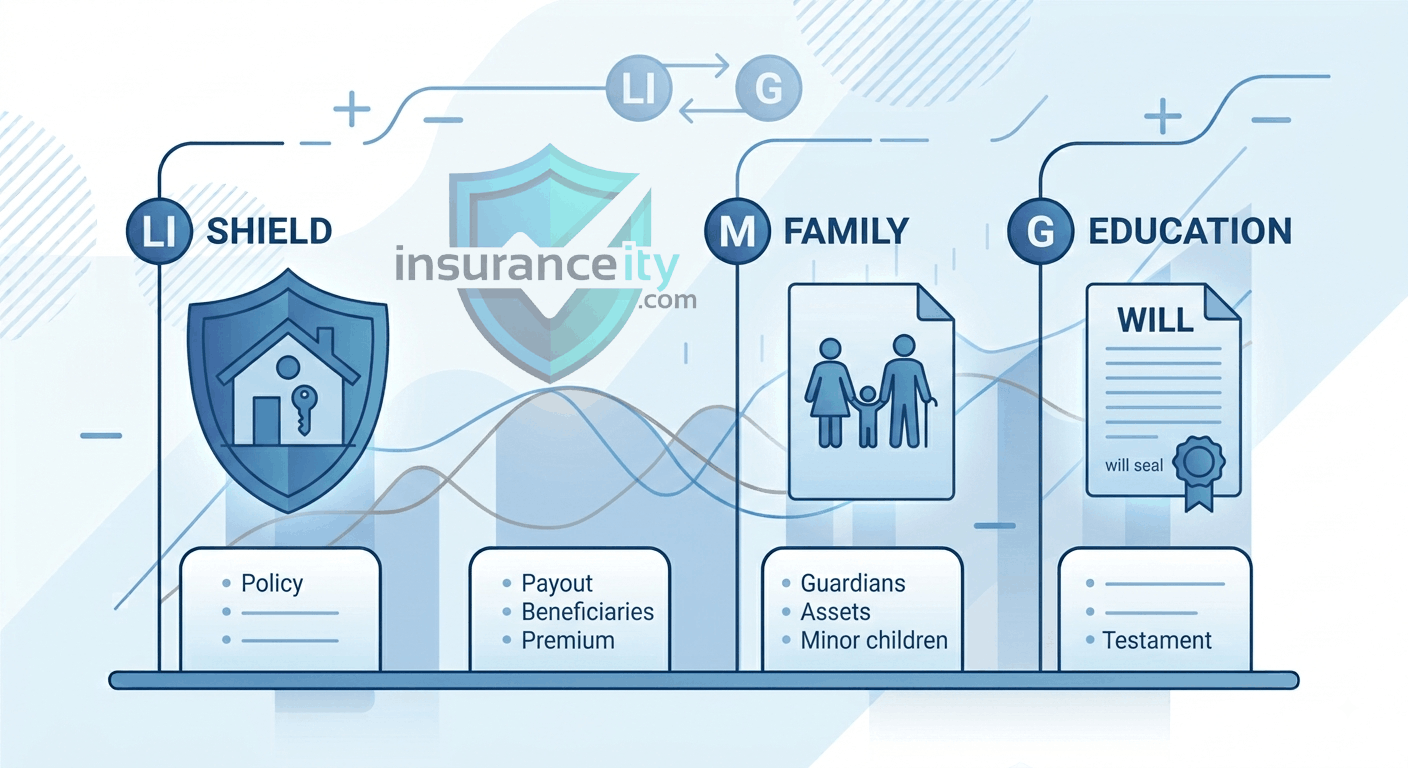
- Life insurance provides the money, but it doesn’t name who raises your children if both parents die. That’s determined by a legal guardianship designation, typically established in a will.
- A life insurance payout can be directed to benefit minor children, but insurers generally won’t pay a large death benefit directly to a minor. Many families use a trust or name a custodian under their state’s Uniform Transfers to Minors Act to manage funds until the child reaches adulthood.
- Reviewing beneficiary designations regularly — especially after a birth, divorce, or other major family change — helps ensure the policy actually functions the way you intend.
Because guardianship and beneficiary structuring involve legal considerations that vary by state, it’s worth discussing your specific plan with an estate planning attorney alongside your insurance purchase.
Family-Relevant Riders Worth Knowing About
Beyond the child rider, a few other riders come up often in family policy planning:
| Rider | What It Does |
|---|---|
| Waiver of premium | Waives premiums if the policyholder becomes disabled and unable to work |
| Term conversion | Allows converting some or all of a term policy to permanent coverage without new medical underwriting |
| Return of premium | Refunds some or all premiums paid if the policyholder outlives the term (typically at a higher overall cost) |
| Accelerated death benefit | Allows early access to a portion of the death benefit for a qualifying terminal or critical illness |
| Cost-of-living adjustment | Increases the death benefit over time to help keep pace with inflation |
Rider availability, cost, and terms vary by insurer, so it’s worth asking specifically which are included versus optional.
How to Choose Life Insurance for Your Family
- Calculate your coverage need using the DIME method (or a similar detailed approach) rather than relying on a flat rule of thumb.
- Decide whether to insure one or both parents, factoring in the real replacement cost of a stay-at-home parent’s contributions, not just salaried income.
- Choose term length based on your youngest child’s timeline to financial independence — a 30-year term for a family with a newborn, a shorter term if children are older.
- Consider a child rider if you want modest, affordable coverage for your kids and value the future conversion privilege.
- Compare quotes from at least three insurers for the same coverage amount and term length, since pricing can vary meaningfully between companies for an identical applicant.
- Review available family-relevant riders, especially waiver of premium and term conversion.
- Coordinate with your estate plan — confirm beneficiary designations and, if you have minor children, how funds would be managed (trust, custodian, or otherwise) if a payout occurred.
- Revisit your coverage after major life changes — a new child, a new mortgage, a change in income, or a parent leaving the workforce.
Common Mistakes Families Make
- Insuring only the working parent. Overlooking a stay-at-home parent’s economic contribution can leave a family financially exposed if that parent dies.
- Using a flat income multiple without adjusting for actual debts and goals. A generic “10x income” figure may miss a mortgage, education goals, or existing debt.
- Relying only on employer group life insurance. Group coverage is often just one or two times salary and typically doesn’t transfer if you leave the job.
- Choosing a term length shorter than your years of dependency. A 10-year term bought when your child is a newborn will expire long before they’re financially independent.
- Forgetting to name a contingent beneficiary, or not updating beneficiaries after a major family change.
- Assuming a child rider replaces the need for an adult policy on each parent. A child rider is a modest supplement, not a substitute for adequately insuring the parents’ income and labor.
- Not coordinating the policy with guardianship and estate planning, which can leave a payout without a clear structure for managing it on behalf of minor children.
Frequently Asked Questions
How much life insurance should a family with kids have?
There’s no single number, but the DIME method (Debt, Income replacement, Mortgage, Education) gives a more tailored estimate than a flat income multiple. Many families end up in the range of several hundred thousand to over a million dollars in coverage, depending on income, debt, and the number and age of children.
Do stay-at-home parents need life insurance?
Yes, in most cases. A stay-at-home parent’s unpaid labor — childcare, household management, and related services — has real financial replacement value. Coverage for a non-earning parent is typically based on the cost of replacing those services rather than an income multiple.
Is term or whole life insurance better for a family?
For most families with young or dependent children, term life insurance is generally the more cost-effective way to cover the years of greatest financial responsibility. Whole life tends to make more sense for specific long-term goals like estate planning or providing for a child with lifelong care needs.
What is a child life insurance rider, and is it worth it?
A child rider adds modest coverage (often $5,000–$25,000) for all your children under one parent’s policy for a single premium. Its main value for many families is the future conversion privilege, which lets a child obtain their own coverage as an adult without new medical underwriting — useful if they develop a health condition later in life.
Who should be the beneficiary of a family life insurance policy?
Most policyholders name a spouse or partner as the primary beneficiary and consider a trust, custodian, or contingent beneficiary arrangement for minor children, since insurers generally won’t pay a large death benefit directly to a minor. An estate planning attorney can help structure this correctly for your state.
Does life insurance name a guardian for my children?
No. Life insurance provides funds but doesn’t determine who raises your children if both parents die — that’s established through a legal guardianship designation, typically in a will. The two should be planned together, not treated as substitutes for each other.
How long should a family’s term life insurance last?
A common approach is matching the term length to your youngest child’s path to financial independence — for example, a 30-year term for a family with a newborn, or a shorter term if children are already teenagers.
Can I add my spouse to my own life insurance policy?
Generally, no — most insurers require each adult to have an individual policy rather than combining two adults under one policy, though a spousal rider can sometimes add limited coverage for a partner. Separate individual policies typically provide more coverage and more flexibility than a rider.
This article provides general educational information about life insurance and is not personalized financial, legal, or insurance advice. Coverage needs, riders, and estate planning considerations vary by family and by state. Consider speaking with a licensed insurance agent, financial advisor, or estate planning attorney for guidance specific to your situation.
Sources
- National Association of Insurance Commissioners (NAIC) — “Life Insurance” — https://content.naic.org/consumer/life-insurance.htm — Consumer-focused regulatory overview of life insurance products and protections.
- NerdWallet — “How Much Life Insurance Do I Need?” — https://www.nerdwallet.com/insurance/life/learn/how-much-life-insurance-do-i-need — Explanation of the DIME method and income-replacement calculations.
- Guardian Life — “How much life insurance do you need?” — https://www.guardianlife.com/life-insurance/how-much-life-insurance-do-you-need — Insurer-published explanation of the DIME method and education-cost estimates.
- MoneyGeek — “5 Best Family Life Insurance Companies (2026)” — https://www.moneygeek.com/insurance/life/best/family/ — Comparative data on child riders, coverage amounts for stay-at-home parents, and family policy structuring.
- MoneyGeek — “Best Life Insurance for Parents in 2026” — https://www.moneygeek.com/insurance/life/best/parents/ — Data on family-relevant riders including child riders and waiver of premium.
- CNBC Select — “The best life insurance companies for children of 2026” — https://www.cnbc.com/select/best-life-insurance-for-children/ — Overview of child life insurance policies, riders, and eligibility rules.