
Best Car Insurance for Drivers With Bad Credit
If your car insurance quote came back higher than expected, credit history is often the reason. In most states, insurers are allowed to factor in something called a credit-based insurance score when setting your premium, and a low score can add hundreds or even thousands of dollars a year to your bill. This article explains how that works, which companies tend to be more competitive for drivers with bad credit, and what you can actually do to bring the cost down.
Quick Answer
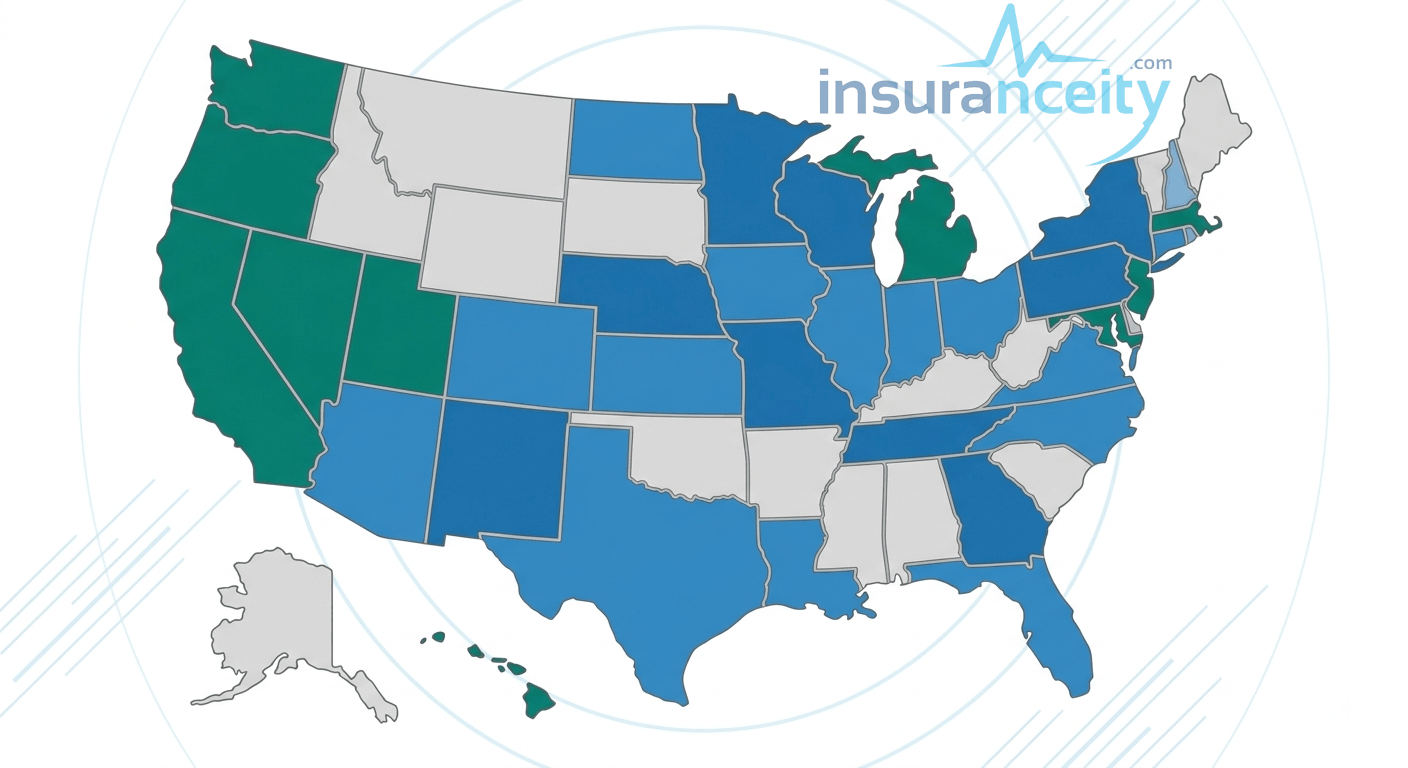
Multiple 2026 rate studies point to GEICO, Nationwide, Travelers, and USAA (for military families) as insurers that frequently offer more competitive rates for drivers with poor credit, though results vary by state and study. Bad credit commonly raises full-coverage premiums by roughly 90–120% compared with excellent credit, according to industry rate analyses. If you live in California, Hawaii, Massachusetts, or Michigan, your credit history can’t be used to set your auto insurance rate at all.
What Is a Credit-Based Insurance Score?
A credit-based insurance score is not the same thing as your FICO credit score, though it’s built from similar underlying data — your payment history, outstanding debt, length of credit history, and how you use credit. Insurers use it because actuarial research has found a statistical correlation between how people manage credit and how likely they are to file an insurance claim. It’s a controversial rating factor: critics argue it can penalize people for financial hardship unrelated to driving risk, which is part of why a small number of states have banned or restricted its use.
Getting an insurance quote typically triggers only a “soft” credit inquiry, which does not affect your regular credit score.
Which States Restrict Credit-Based Insurance Scoring
This is one of the most important things a driver with bad credit can know, because it determines whether credit affects your rate at all.
| State | Restriction |
|---|---|
| California | Full ban — credit cannot be used to set auto insurance rates |
| Hawaii | Full ban for auto insurance |
| Massachusetts | Full ban for auto insurance |
| Michigan | Full ban for auto insurance |
| Maryland | Partial restriction — credit can affect new-policy pricing but not renewals or cancellations |
| Oregon | Partial restriction |
| Utah | Partial restriction |
Several other states, including Nevada, impose additional limits on how credit-based scoring can be used, and the list of restricted states has changed through legislation in recent years. If you’re unsure whether your state restricts credit-based scoring, your state insurance department can confirm the current rules — this is not something to assume based on a general list, since regulations can change.
How Much Does Bad Credit Raise Car Insurance Rates?
The exact increase varies by study and by insurer, but the pattern is consistent: several independent 2026 rate analyses report that drivers with poor credit pay somewhere in the range of 90% to roughly 120% more for full coverage than drivers with excellent credit — in dollar terms, commonly cited as an increase of $1,500 to $3,000 or more per year, depending on the insurer and the driver’s other risk factors.
Importantly, the size of that increase varies dramatically by company. Some insurers apply a much steeper credit-based surcharge than others, which is exactly why shopping around matters more for drivers with bad credit than for almost any other group — the gap between the most and least expensive insurer for the same bad-credit driver can be very large.
Best Car Insurance Companies for Drivers With Bad Credit
No single company is “the cheapest” for every bad-credit driver — availability and pricing shift by state and individual profile. That said, several insurers appear repeatedly across independent 2026 studies as more competitive options for this group.
| Insurer | Best For | Why It Stands Out | Important Consideration |
|---|---|---|---|
| GEICO | Budget-conscious shoppers nationally | Frequently cited as having some of the most competitive base rates for drivers with poor credit, even after a credit-based surcharge | Rates and surcharge size vary by state |
| USAA | Military families | Often the lowest-cost option in studies that include it | Only available to active-duty military, veterans, and their immediate family |
| Travelers | Nationwide availability, low complaints | Frequently ranked as a low-complaint, competitively priced option for bad-credit drivers | Sold mainly through independent agents |
| Nationwide | Broad availability with review tools | Offers a free annual coverage review and is widely available | Customer satisfaction scores are sometimes below competitors’ |
| State Farm | Local agent support | Large agent network for drivers who want in-person service | Some studies show State Farm applying a steeper credit-based surcharge than competitors |
| NJM / regional carriers | Drivers in a state where they’re sold | Regional insurers sometimes beat national brands specifically for bad-credit pricing | Availability limited to a handful of states |
Because the size of the credit-based surcharge varies so much by company, getting direct quotes is the only reliable way to find your actual best option — a company that’s cited as competitive nationally may not be the cheapest for your specific state and profile.
Coverage Basics for Bad-Credit Shoppers
Bad credit affects your price, not what coverage you’re eligible to buy. The core coverage types work the same way regardless of credit:
| Coverage | What It Covers | What It Doesn’t Cover |
|---|---|---|
| Bodily injury liability | Medical costs for others if you’re at fault | Your own injuries |
| Property damage liability | Repairs to another person’s property you damage | Damage to your own vehicle |
| Collision | Damage to your own car in a crash, regardless of fault | Damage to others’ property |
| Comprehensive | Non-collision damage: theft, weather, vandalism | Collision damage |
| Uninsured/underinsured motorist | Costs if the at-fault driver has no or insufficient insurance | Damage you cause |
Liability coverage is required in nearly every state (New Hampshire is the exception, though it still requires proof you can cover damages you cause). Collision and comprehensive are optional but usually required if you’re financing or leasing.
If your budget is especially tight because of a credit-based surcharge, it can be tempting to drop down to state-minimum liability only. That’s a legitimate way to lower cost, but it’s worth understanding the trade-off: minimum coverage may not be enough to cover a serious at-fault accident, which could leave you personally responsible for costs above your policy’s limits.
Ways to Lower Your Rate That Don’t Depend on Credit
- Compare quotes from at least three to five insurers. Because credit-based surcharges vary so widely by company, this is the single most effective step for a bad-credit driver.
- Ask about usage-based / telematics programs. Programs that track actual driving behavior (braking, speed, mileage) can offset a weak credit-based score with several insurers, since they price based on how you actually drive rather than your financial history.
- Maintain a clean driving record. Driving history is typically weighted as heavily as, or more heavily than, credit in most states, so avoiding tickets and accidents helps regardless of your credit score.
- Ask about every discount you might qualify for, including multi-policy (bundling), multi-vehicle, good driver, low-mileage, and paid-in-full or autopay discounts.
- Consider raising your deductible if you can afford the higher out-of-pocket cost in a claim, which lowers your premium.
- Work on improving your credit over time. Since insurers commonly re-check credit at renewal, a stronger score at your next renewal may lower your rate — though the specific impact varies by insurer and state.
- Move to state-minimum coverage carefully, understanding the coverage trade-off described above, if your budget genuinely requires it short-term.
None of these steps guarantees a specific dollar savings — actual results vary by insurer, state, and individual circumstances.
Common Mistakes to Avoid
- Assuming you can’t get coverage because of bad credit. Insurers rarely deny coverage outright based on credit alone; it affects price, not eligibility, in states where it’s used at all.
- Only getting one quote. Because the credit-based surcharge varies so much between companies, a driver with bad credit has more to gain from comparison shopping than almost any other group.
- Letting coverage lapse to save money short-term. A coverage gap can raise future premiums even further and is illegal in most states while a vehicle remains registered.
- Not asking whether your state restricts credit-based scoring. Drivers in California, Hawaii, Massachusetts, and Michigan may be paying attention to a rating factor that doesn’t apply to them at all.
- Ignoring usage-based programs. These can be one of the more effective ways to offset a credit-related surcharge, but they require opting in — they’re not automatic.
- Choosing state-minimum coverage without weighing the risk. It’s the cheapest legal option, but it can leave you financially exposed after a serious accident.
How to Shop for Bad-Credit Car Insurance
- Check whether your state restricts credit-based scoring before assuming it applies to your quote.
- Get quotes from multiple insurers, including at least one regional carrier if available in your state.
- Compare identical coverage limits and deductibles across every quote so you’re comparing like for like.
- Ask each insurer directly how much of your quote is attributable to credit, and whether a usage-based program is available.
- Check the insurer’s financial strength (AM Best) and complaint record with your state insurance department, especially if you’re considering a less familiar company for the sake of price.
- Re-shop at renewal, particularly after any meaningful improvement to your credit history.
- Read the policy before buying, so you understand any exclusions or coverage gaps that come with a lower-cost plan.
Frequently Asked Questions
Can I be denied car insurance because of bad credit?
Generally, no. Insurers in most states may charge more for a lower credit-based insurance score, but they don’t typically deny coverage outright based on credit alone. Some states also restrict insurers from canceling or non-renewing a policy based on credit.
Does checking my credit for an insurance quote hurt my credit score?
No. Insurance quotes typically use a soft credit inquiry, which does not affect your regular credit score, unlike a hard inquiry from a loan or credit card application.
Will improving my credit lower my car insurance rate?
It can, since many insurers re-check credit at renewal and may adjust pricing based on your updated score. The size of any change depends on the insurer and your state, and some companies allow you to request a mid-term re-rate after a significant credit improvement.
Which states don’t use credit for car insurance pricing?
California, Hawaii, Massachusetts, and Michigan fully prohibit the use of credit-based insurance scoring for auto insurance. Maryland, Oregon, and Utah impose partial restrictions. Rules can change through state legislation, so it’s worth confirming current status with your state insurance department.
Is it worth getting a usage-based (telematics) insurance program if I have bad credit?
For many drivers, yes. These programs base part of your rate on actual driving behavior rather than credit history, which can help offset a credit-related surcharge, particularly if you’re a safe or low-mileage driver.
What’s the cheapest car insurance company for bad credit?
There’s no single answer — GEICO, USAA (for eligible military families), Travelers, and Nationwide are frequently cited as competitive options in 2026 rate studies, but the cheapest option for you depends on your state, driving record, and vehicle. Comparing direct quotes is the only reliable way to know.
Does bad credit affect all types of insurance the same way?
No. Credit-based scoring rules and its impact on price can differ between auto, homeowners, and other insurance lines, and state restrictions don’t always apply equally across all types. This article focuses specifically on auto insurance.
This article provides general educational information about car insurance and is not personalized financial, legal, or insurance advice. Insurance pricing, credit-scoring rules, and state regulations change over time. Confirm current rules with your state insurance department and get personalized quotes directly from insurers or a licensed agent before making a purchasing decision.
Sources
- National Association of Insurance Commissioners (NAIC) — “Auto Insurance” — https://content.naic.org/insurance-topics/auto-insurance — Regulatory overview of auto insurance rating practices.
- Forbes Advisor — “Best Car Insurance For Drivers With Bad Credit” — https://www.forbes.com/advisor/car-insurance/best-car-insurance-for-bad-credit/ — Independent evaluation of insurers on rates, complaints, and service for bad-credit drivers.
- CNBC Select — “Best car insurance for bad credit in 2026” — https://www.cnbc.com/select/best-car-insurance-bad-credit/ — Rate analysis and state restriction list for credit-based insurance scoring.
- Insure.com — “Best car insurance for bad credit in 2026” — https://www.insure.com/car-insurance/car-insurance-for-bad-credit/ — Company-by-company average rate data for drivers with poor credit.
- LendingTree — “Cheapest Car Insurance for Bad Credit” — https://www.lendingtree.com/car-insurance/car-insurance-for-bad-credit/ — Comparative rate analysis including regional insurers.
- Compare.com — “The Best Car Insurance for Drivers With Bad Credit” — https://www.compare.com/auto-insurance/cheap-car-insurance/cheap-car-insurance-bad-credit — Company comparison and explanation of credit-based insurance scoring.
- CNBC — “Home, car insurance rates based on credit history face state scrutiny” — https://www.cnbc.com/2026/04/26/insurance-rates-credit-history.html — Coverage of which states restrict or are considering restricting credit-based scoring.





1 thought on “Best Car Insurance for Drivers With Bad Credit (2026)”